AN ANCIENT SCRIPT DECODER

Ea-Nasir
Complaint Reader

Turning a 3,700-year-old customer complaint into structured, explorable data.

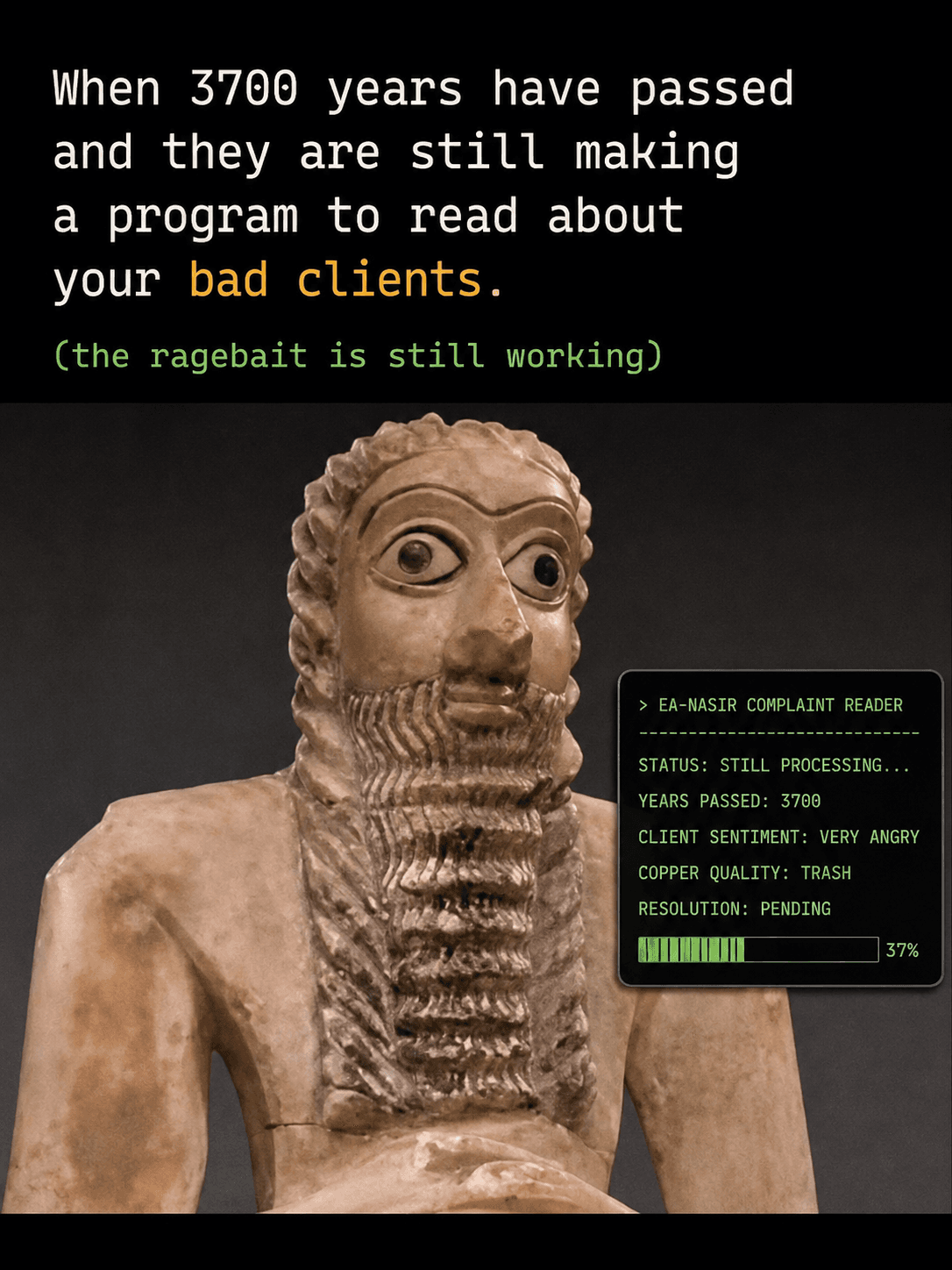
Ea-Nasir meme about his infamous copper complaint

THE 3,700-YEAR-OLD DRAMA

So... who was Ea-Nasir?

Around 1750 BCE, a man named Nanni sent a clay tablet to the merchant Ea-Nasir complaining about the quality and delivery of his copper.

Ea-Nasir probably did not expect that his customer service problem would still be discussed thousands of years later.

This project uses the surviving scholarly transcription of that tablet to explore how ancient writing can be parsed, analyzed and represented computationally.

READ THE COMPLAINT

The Complaint

A 3,700-year-old customer service disaster.

Tell Ea-Nasir: Nanni sends the following message.

When you came to me, you said that you would give Gimil-Sin good-quality copper ingots. You left, but you did not do what you had promised.

You presented my messenger with ingots that were not of acceptable quality and told him to take them or leave them.

Do you really think you can treat me this way? I have sent respectable men to collect the money entrusted to you, and you have repeatedly sent them back empty-handed.

You have also shown contempt for my messenger by making him travel through hostile territory without proper consideration.

From now on, I will not accept copper from you unless I inspect it myself and find it satisfactory.

If the copper is poor quality, I will reject it. I will choose the ingots individually, and I will exercise my right to refuse them.

You have treated me badly, and I expect this matter to be handled properly.

English project rendering for readability. The original Akkadian scholarly transcription is preserved separately and can be explored in the reader below.
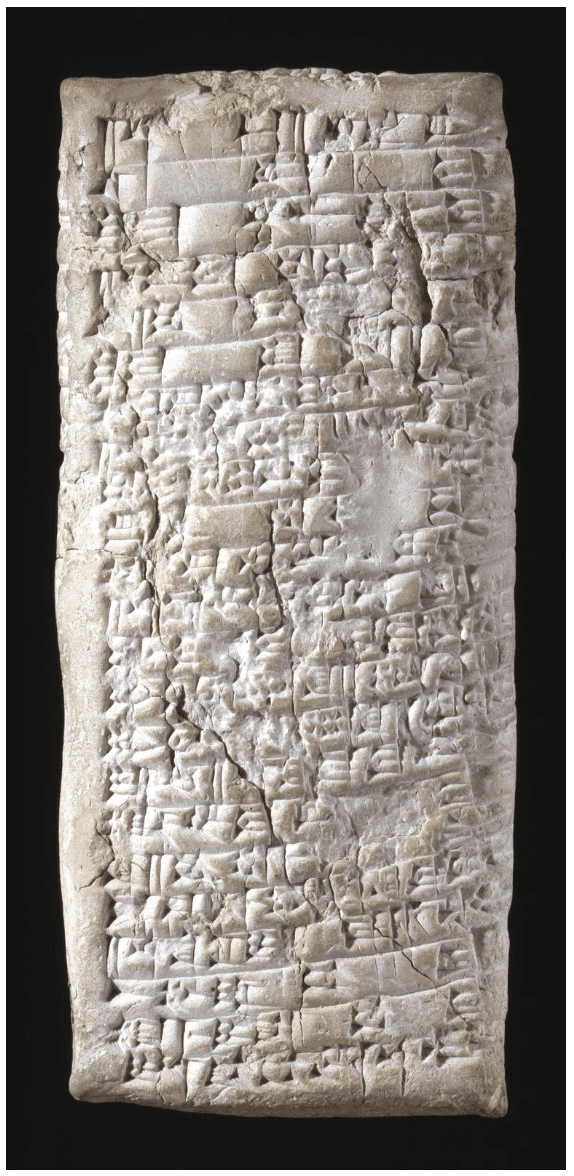
THE ARTIFACT

About the tablet.

CDLI IDP414985
DesignationUET 5, 0081
Museum NumberBM 131236
LanguageAkkadian
PeriodOld Babylonian
Dateca. 1750 BCE
ProvenienceUr
Materialclay

HOW IT WORKS

From clay to structured data.

ATF Source→Parse→Tokenize→OSL Lookup→Analyze→Display

THE READER

Explore the tablet.

abDamagedabMissingxUnknowndDeterminativeabUncertain
Ea-Nasir complaint tablet

Viewing: Obverse

Obverse

1
a-na e2-a-na-s,i-ir
2
qi2-bi2-ma
3
um-ma na-an-ni-ma
4
a-nu-u2-ma ta-al-li-ku
5
ki-a-am ta-aq#-bi#-am#
6
um-ma at-ta-a-ma
7
gu-ba-ri da-am-qu2-tim
8
a-na gi-mil-{d}suen a-na-ad#-di-in
9
ta-al-li-ik-ma ta#-aq-bi-a-am
10
u2-la te-pu#-usz
11
gu-ba-ri la da-am#-qu2-tim
12
a-na ma-ar szi-ip-ri-ia
13
ta-asz-ku-un#-ma um-ma at-ta-ma
14
szum-ma te-le-qe2-a le-qe2-a
15
szum-ma [la] te#-le-qe2-a at-la-ka
16
ia-ti a-na ki-ma ma-an-ni-im
17
tu-szi-im-ma ni-x-(x)-x-x-ma
18
ki-a-am te-me-sza#-an#-ni
19
ma-ri a-wi-li a-na ki-ma ka-ti
20
a-na ki-si-ia ma-ha-ri-im
21
asz-pu-ra-am-ma
22
tu-me-i-sza-am-ma
23
i-na qa2-qa2-ar na-ak-ri-im

ABOUT THE PROJECT

Ancient writing, modern tooling.

Ea-Nasir Complaint Reader is an experimental software engineering and digital humanities project built around real cuneiform data, scholarly sign lists and an interactive decoding pipeline.

SYSTEM ARCHITECTURE

How the reader actually works.

The interface is only the final layer. Behind it, the project processes scholarly cuneiform data through a Python pipeline before exposing structured information to the interactive reader.

01CDLI ATF

Scholarly transliteration of the original tablet.

→
02ATF Parser

Python reconstructs surfaces, lines and words.

→
03Tokenizer

Words are decomposed into individual sign readings.

→
04ORACC OSL

Readings are matched against scholarly sign data.

→
05Decoder

Candidate signs, Unicode and metadata are attached.

→
06Next.js Reader

Structured data becomes an interactive exploration.

BACKENDPython

Parsing, tokenization, scholarly lookup, decoding and data export.

SCHOLARLY DATACDLI + ORACC OSL

Primary transliteration, artifact metadata, sign readings and Unicode mappings.

FRONTENDNext.js + React

Interactive tablet navigation, sign inspection and presentation.

NEXT: IMAGE READING

From tablet photograph to candidate signs.

Tablet Image→Image Processing→Glyph Detection→Candidate Classification→OSL Lookup→Contextual Ranking

The long-term goal is not to ask an AI model to simply “read the tablet.” The image layer will identify possible glyphs, while the existing deterministic pipeline handles sign lookup, scholarly data and candidate analysis.